Tone Parallel
Issue 1 October 2021

For tho' from out our bourne of Time and Place
The flood may bear me far,
I hope to see my Pilot face to face
When I have crost the bar.
Alfred, Lord Tennyson
Thank you for subscribing and welcome to the first issue of Tone Parallel, a quarterly newsletter dedicated to the music of Duke Ellington.
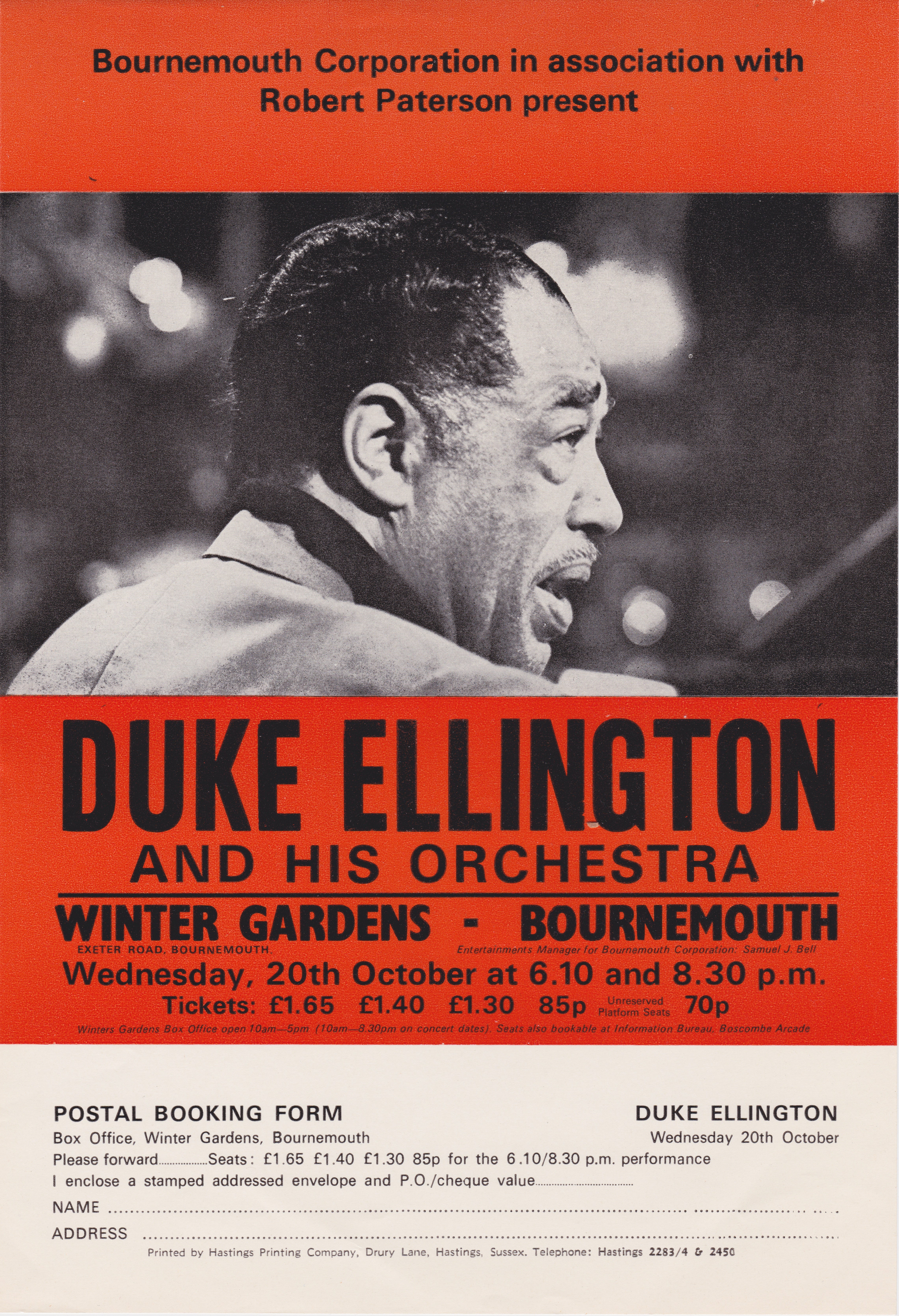
This edition is being published for 20 October 2021 which happens to be the fiftieth anniversary of Duke Ellington’s appearance at the Winter Gardens, Bournemouth, a seaside resort on the south coast of England.
Bourne or bourn is an interesting word. In Old English, it meant a stream or river. On 20 October 1971, therefore, it could be said that Duke Ellington and his Orchestra performed at the mouth of the stream. And in another concert appearance some two years later which comprised a celebrated commercial release on LP (Eastbourne Performance) the Orchestra, it could be said, then, appeared east of the stream.
Tracing the journey between these two appearances, which will be one of the themes of Tone Parallel, brings thoughts of the modern meaning of the word bourneas it is used in the lines by Tennyson which preface this piece. Here, the word means limit or boundary as in Hamlet’s “undiscovered country from whose bourn no traveller returns.”
With what equanimity Ellington faced this certain destination, we will never know. What we can say is that, like the speaker in Tennyson’s poem Crossing the Bar, he travelled in the hope of seeing his Pilot face to face. This much is evident in the sacred music he wrote in these years, culminating in the only complete and transcendent performance of The Third Sacred Concert which he gave at Westminster Abbey in October 1973 in what might be termed the Winter Gardens of his life.
And so to Bournemouth.
Duke Ellington and his Orchestra played two houses at the Winter Gardens on Wednesday, 20 October 1971. We have the set lists for both performances drawn, doubtless, from the audience made recordings which comprise many of the entries in the Duke Ellington sessionography.
A fifty-year-old typewritten list also survives, however, from that time compiled by the late Richard Davis, attending both concerts with his wife, Barbara. Richard was one of the many thousands of fans of Duke Ellington who attended the concerts Ellington gave on his numerous visits to the UK from 1958 onwards. This edition of Tone Parallel, is a celebration of both the anniversary of Ellington’s UK tour in 1971 and aficionados of Duke’s work such as Richard whose efforts collecting material “over many years” in the words of Barbara bring days such as that Wednesday in Brighton in Autumn so much closer.
The flyer for the Bournemouth concerts which adorns the top of this newsletter is an example of the poignant ephemera Richard collected and his typed up set list is such another. According to Richard Davis, the first house consisted of the following selections:
C-Jam Blues (Cootie)
Black And Tan Fantasy
Creole Love Call (Cootie)
The Mooche (Procope)
Rocking in Rhythm
Happy Reunion (Gonsalves)
Take The A-Train (5 sax; 1 cl.)
Fife (Norris Turney)
from Afro-Eurasian Eclipse
(Asby; Ell. P. intro)
A Tone Parallel to Harlem (full) Cootie tpt.
Interval
Perdido (Harold Johnson tpt.)
- Rufus Jones & Harold Minerve and drum solo by Jones
Medley, including Mood Indigo
(Carney, Procope and tbn)
In my Solitude (vcl. Watkins)
It Don't Mean A Thing (vcl. T. W.)
I Got It Bad (f. vcl &Cootie)
I Got the Blues (f. vcl)
Sophisticated Lady (Carney)
Caravan (‘Money Jungle’ arrangement)
Jean Lafitte (from New Orleans, Carney & John Coles, f’horn)
Lotus Blossom (Ell. P. solo, for “little Billy Strayhorn”)
How High The Moon (Ell. & Eddie Preston, tpt.
-----------------
Presumably Richard noted down the titles during the concert and typed up the list when he got home. It is remarkably accurate. The discographies later identified Chinoiserieas the number from The Afro-Eurasian Eclipse, Harold Minerve’s solo and Rufus Jones’s drum solo following Perdidowere Addiand Come Off The Veldt. The unidentified female vocalist was Nell Brookshire.
Among the other souvenirs in Richard’s papers from Ellington’s UK tour in 1971 is a particularly poignant document: a carbon copy of a typed letter Mr Davis sent to Duke Ellington himself. The letter is dated 20 October and it would be reasonable to assume, therefore, that the letter may well have been delivered to the theatre by hand on the day of the concert for the attention of Mr Ellington. We learn from the letter that the two shows Ellington and his orchestra performed took place at 6:10pm and 8:30pm. Richard and his wife attended both houses.
Here are the contents of the letter…
20 October, 1971
Dear Duke,
It’s great to be able to say WELCOME BACKto this particular neck of the woods once more.
It has been a very l-o-n-g time since Sunday 30th November, 1969!
Thank you for the two wonderful concerts at the Winter Gardens on that evening; the memory is still very fresh. But much more, thank you for coming again.
On that evening, you were gracious enough to get the orchestra to autograph the sleeve of the Billy Strayhorn album for us. May we ask if You & the Duke’s Men would autograph the New Orleans Suite (and a couple of programmes) for us, if you have the time this evening please?
Of course, we’d love to hear the whole of the New Orleans Suite ‘live’ tonight – and of course that’s impossible! But if you could play just one request from it, the difficult choice from a superb album has to be Second Line.
I can’t express how much joyyour music continues to bring into our lives, Duke. There are very few days when an Ellington record isn’t played at (our house), Bournemouth. Thank you – THANK YOU, for every beautiful note of it.
Once again, WELCOME BACK. My wife and I will be loving you all madly, from Row L at 6.10 and in the front row centre at 8.30 . . .
P.S. We hope the Russia tour was a great success.
The letter is written effusively and conveys very effectively the effect Ellington and his music have on his fans. Richard expresses sentiments to which the bosom of many an admirer of Ellington’s work returns an echo. His knowledge of Ellington’s itinerary is evident in his reference to the recent tour of the USSR. The request for Second Lineis particularly interesting. Requests are often put to musicians for a particular number sometimes without realizing that the ‘pad’ or library carried by an aggregation as large as Ellington’s ahead of a tour, voluminous though it undoubtedly may be, would never be large enough to contain all the numbers possibly requested. In his stage patter, Ellington would frequently say something along the lines of “We have a heavy request for…” In these instances, however, whether the request was actually made or no, what usually follows is Satin Doll or Sophisticated Lady, warhorses which were trotted out at just about every public performance. It is unlikely that the touring library was as deep as to cover requests from such ardent Ellington aficionados as Second Line. We can see from the set list that Ellington did indeed include a selection from the New Orleans Suite with Aristocracy à la Jean Lafitte. It is unlikely that this was a response to Richard’s request, however; the number was in the book in concerts prior to the Orchestra departing for Europe and was played several times during their European tour.
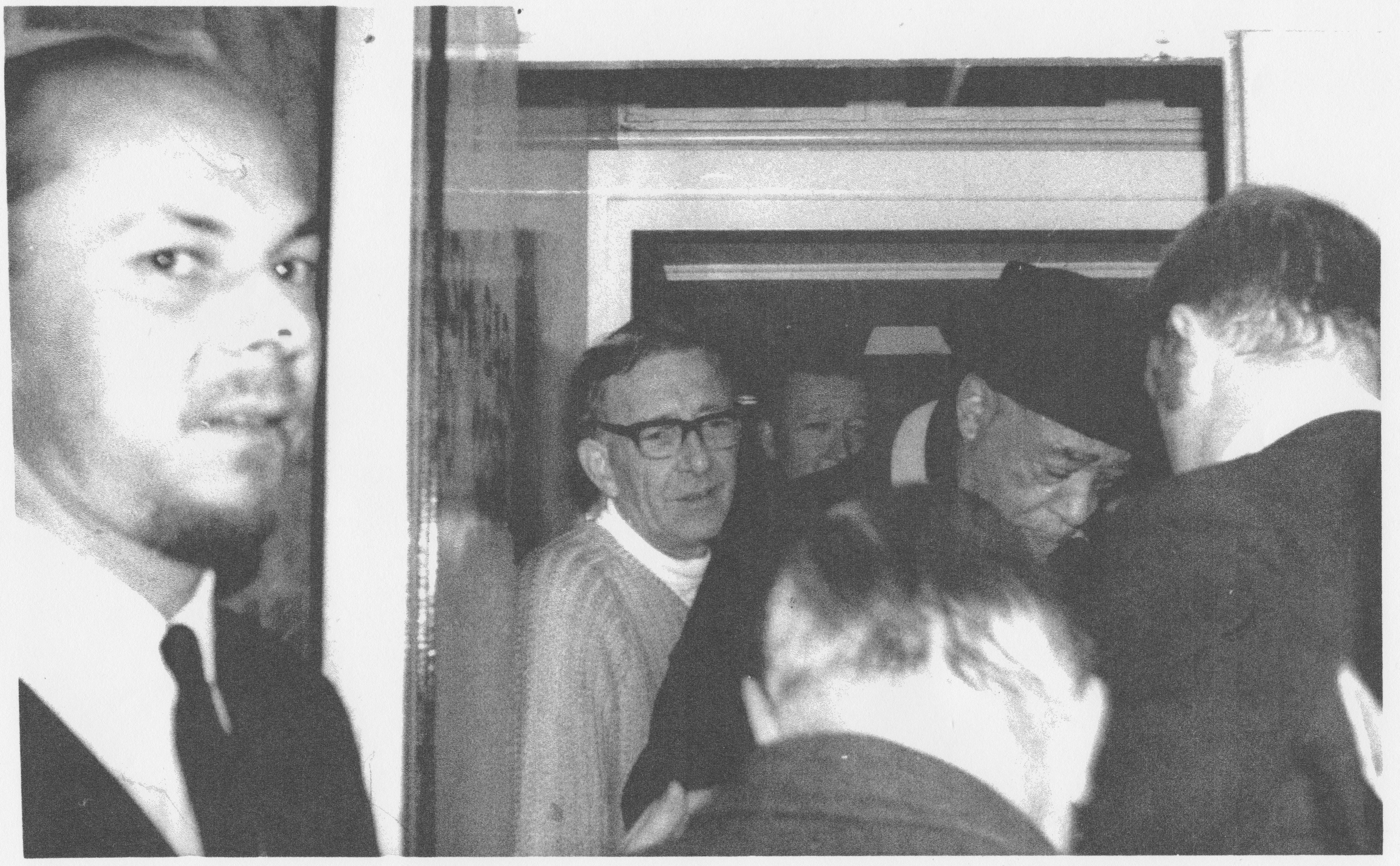
That Richard Davis did indeed get to spend some time with his idol is clear, however, fro the photographs taken back stage. Here is one shot from those taken that evening, 20 October, 1971…
Appended to Richard’s typed copy of the set list are the variations in programming in the second concert of the evening.
Second concert:- omit Tone Parallel
And add Satin Doll and La Plus Belle Africaine
Birmingham: Lotus Blossom p. solo
replaced by superb Retrospection (sic) in D.
17 in band. Cootie + 4 tpts; 3 tbn; 6 saxes.
We can see, too, that in addition to the Bournemouth concerts, Richard Davis was also present at the concerts given in Birmingham some three days later on 24 October.
Now this is very interesting because selections from those two concerts at the Birmingham Hippodrome (where Ellington also appeared on his first British tour in 1933) were released as part of a double album called The English Concert released originally on the United Artists label. Playing that albums today, then, and hearing the response of the audience after C-Jam Blues or Cotton Tail, is it possible to pick out the hands of Richard Davis and his wife “tiny in all that air, applauding”? How entirely fitting that Richard Davis has become immortalized in one sense, woven forever within the story of his hero, Duke Ellington.
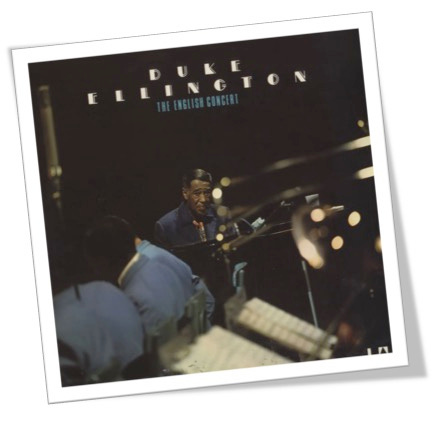
Togo Brava Suite
The English Concertsis a superb album, often overlooked in the Ellington canon. The recording quality is of the highest fidelity, the selections comprising an unusual and, in many ways, unique programme. The album, issued on both United Artists and in the USA on Blue Note as Togo Brava Suiteis long out of print on CD and seems not to have been taken up by the usual streaming services. The original vinyl turns up fairly frequently in the on-line auction houses and is well worth tracking down.
The majority of the double album was actually taken from a recording of the concert Ellington and the Orchestra gave at Colston Hall, Bristol on 22 October. During this concert alone on the UK leg of his tour, Ellington played Togo Brava Suite, a composition he had recorded in its entirety earlier in the year for a ‘stockpile’ session. It is a particularly savage irony that the suite, honouring the Republic of Togo in West Africa which had put Ellington’s portrait on a stamp in 1967 to celebrate the 20thanniversary of UNESCO, should be played – and recorded – at Colston Hall which has been renamed recently Bristol Beacon due to Edward Colston’s involvement with the slave trade. It is unlikely that Ellington was unaware of this irony and, as ever, his music overcame, “saying it without saying it,” as his music had done all his political life.
Ellington was one of four composers celebrated on the series of stamps issued by the Republic of Togo, the remaining three being Bach, Beethoven and Debussy. The fugitive aspects of Ellington’s music frequently recall Bach and in the suite composed to return the compliment to Togo, we hear in this work echoes of Beethoven in the stentorian themes of the suite’s finale and the Impressionism of Debussy in the palette of colours employed, particularly the flute of Norris Turney. Indeed, in his commentary in the Bristol performance, Ellington’s description of the opening movement, Soul Soothing Beach, of “a hundred miles of beautiful silver sand beach with a southern exposure facing the equator on the western bulge of Africa” conjures quite specifically both the colour of Turney’s instrument and his solo.
As Stefano Zenni argues in his superb essay The Aesthetics of Duke Ellington’s Suites, (Black Music Research Journal, Vol. 21, No. 1, Spring, 2001), “The structure in four movements made it easier for Ellington to find an underlying narrative leitmotif, to which the author also referred when presenting the work in concert: the first movement, relaxed and evocative, describes arriving on the "silvery" shores of Togo; the vigorous blues with a powerful finale, Naturellement, stands for moving into the jungle (the words that Ellington spoke into the microphone were "And now into the jungle!"); Amour, Amour, the classical third movement, mysterious and seductive, symbolizes discovering woman in the heart ofthe jungle, a theme recurrent since the days of the Cotton Club; Right on Togo is the joyful closing gospel, celebrating the return to the civilization of modem-day Togo (it is actually too short an episode, not much more than a sketch and not enough to complete the work convincingly). And yet Ellington must have been satisfied with this sequence of movements, because it is the sequence that is found on the double LP…”
Ellington recorded the complete suite of seven movements in February 1971 drawing from a larger matrix, a projected African suite from which he also created the contemporaneousAfro-Eurasian Eclipse. I have created a playlist on Spotify of this matrix, in part, entitled Afro-Eurasian Variations which may be found here:
In concert, only the first, third, fourth and fifth movements (Soul Soothing Beachor Mkis; Naturellement or Yoyo; Amour, Amour or Too Kee and Right On Togo or Buss) were ever performed live. Ellington must surely have been aware that its performance in Bristol was to be included on the release of a commercial album and was quite literally, then, on the record. Even so, this was not the ‘definitive’ version of the work (as if there were ever any ‘definitive’ incarnation of an Ellington work) for in subsequent performances into 1972, he swapped the second and fourth parts of the four-part iteration around and, indeed, eventually reduced the suite to three parts only in performance, when he dropped Naturellement.
Stefano Zenni argues this excision is possibly because drummer Rufus Jones was no longer with the band. This strikes me as a profound insight. It is well known that Ellington never scored the drum parts in his compositions. I wonder whether this, is in part, the legacy of Sonny Greer, who used to argue that Duke Ellington was in his band. Drummers were expected to find their own way. When Sam Woodyard stopped being a regular member of the Orchestra in the mid-sixties, Ellington had quite a time finding a suitable permanent replacement. Jones performed a brief stint with the band late 1966 and then returned in 1968 for a stay of five years. The drums were, perhaps, the bedrock of the band, the non-written nature of the responsibility bringing real improvisation, impulse and authenticity to the music. There was quite some focus on African-inspired music during the period Rufus Jones was with the band. La Plus Belle Africane, of course, pre-dates his involvement (just) but it became a mainstay of the book in the late sixties; Come Off The Veldt was another fixture in the programme consisting entirely of an extended drum solo. This number did survive in the book following Jones’s departure (just) but it may have been felt that Jones’s particular authenticity with regard to Togo Brava Suite was irreplaceable. After he left Ellington, it would seem that Jones did very little in the recording studio. According to Tom Lord, The Jazz Discography, Rufus Jones is listed in the index as playing drums and spoons. If this is one and the same person as Ellington’s drummer, it would appear he was present at only one, final session. This took place "possibly” in Kathleen, Georgia sometime between 1976 and 1979 for blues guitarist John Lee Ziegler where he is, indeed, listed as playing the spoons. Some further digging may be required…
It may well be that Ellington felt Jones was indispensable to the authenticity of Naturellement and dropped the movement after Jones had left. It could be argued, equally, however, that ending the suite now on something of a diminuendo with Amour, Amour was possibly more in keeping with the mood in this the ‘final curtain’ of Ellington’s career. In this arrangement it is the piano player who has the last word which is as it should be.
While The English Concert is not available for streaming, the live performance of Togo Brava Suite is available on YouTube (uploaded by Reminiscing in Tempo whose channel is recommended as a fount of Ellingtonian goodies).
In the next edition of Tone Parallel, due at the end of January, we will visit Oregon in 1970 for a unique performance by Duke Ellington and his Orchestra via a recently discovered ‘lost’ tape.
Thanks for reading!